
End-to-end WordPress platform build supporting a non profit childcare center’s reopening and community reset.
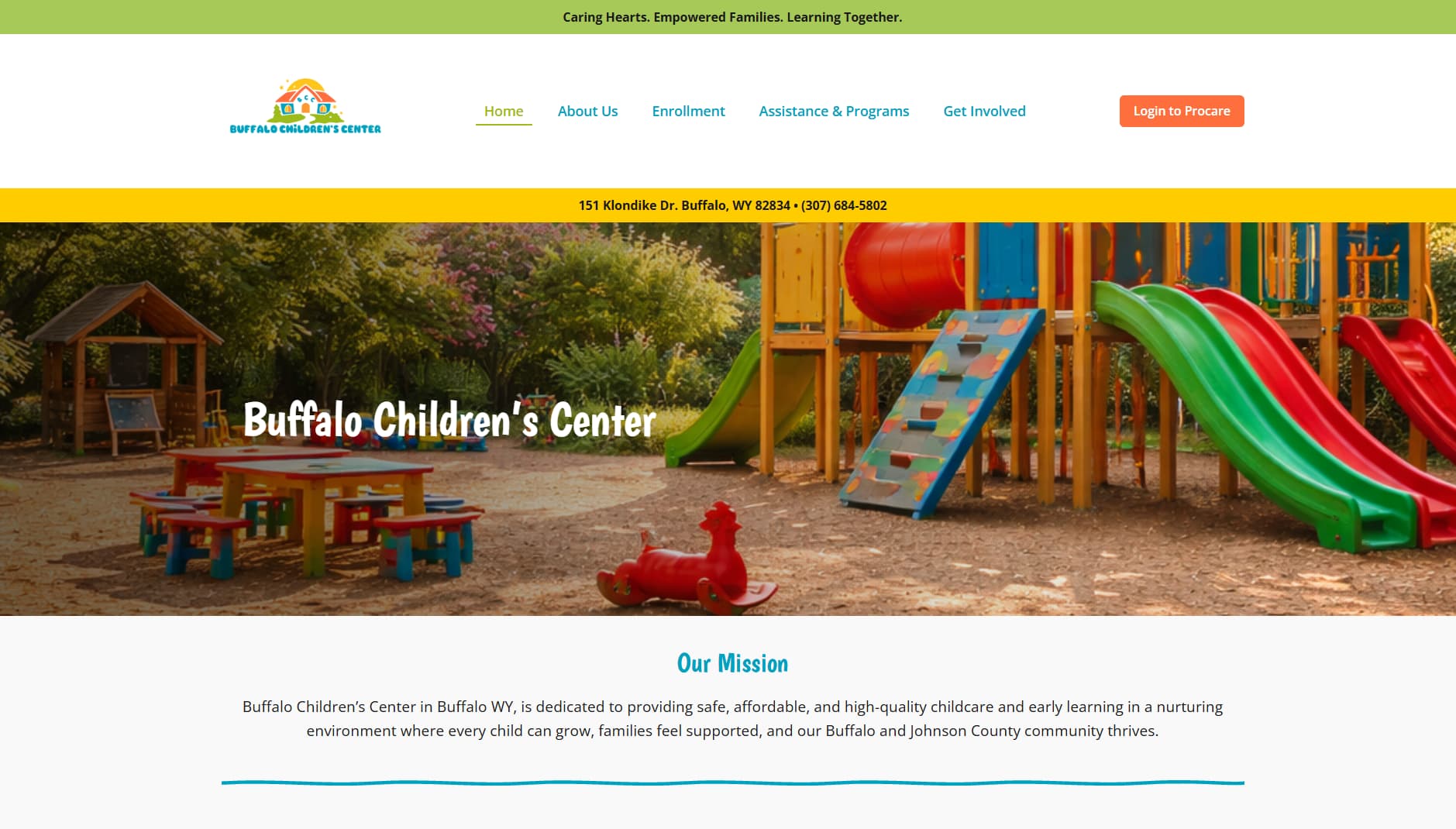
BCC homepage — launch state, December 2025
Buffalo Children’s Center is one of Buffalo, Wyoming’s longest-standing childcare providers. After years of mismanagement led to temporary closure, new leadership began rebuilding the organization and restoring trust in the community. As part of that reset, I designed and launched the center’s first website. The goal was to create a modern, clear digital presence that supported enrollment, prioritized mobile usability, provided direct access to the childcare software used by parents and staff, and helped rebuild trust in the community.
Organization: Buffalo Children’s Center
Project Type: End-to-end WordPress website architecture, development, and launch
Role: Website architect and developer
Timeline: December 2025 – February 2026
Stack: WordPress (Twenty Twenty-Four), Gutenberg block build, custom CSS, Yoast SEO, GA4, Google Search Console
Hosting: WordPress Hosting
Live Site: https://bccwyo.org
Launch State: Technical SEO baseline implemented; GA4 and Search Console configured and verified; indexing confirmed at launch.
Primary Objective: Establish a credible, modern digital presence for a nonprofit childcare center recovering from closure and clearly signal a reset to the community.
Buffalo Children’s Center is one of Buffalo, Wyoming’s longest-standing childcare providers. After years of mismanagement, the organization temporarily closed and began reopening under new leadership. In a community with limited childcare alternatives, that disruption directly affected local families and made restoring confidence a priority.
Reopening required more than operational change. The center needed a clear public reset that communicated stability, professionalism, and renewed commitment to children and the community. Establishing a modern digital presence became part of that reset, giving families a credible place to find information, understand services, and engage with the organization going forward.
Goals
● Establish a modern, fully functioning website in a market where most local businesses rely solely on Facebook, reinforcing credibility and rebuilding confidence.
● Create a centralized digital hub for enrollment, communication, and childcare software access.
● Build a durable structure manageable by minimally trained staff and capable of future expansion.
● Balance professionalism and warmth while prioritizing mobile usability and foundational SEO visibility.
Constraints
● Zero development budget beyond hosting and WordPress Business; reliance on native tools and restrained plugin use.
● Tight timeline aligned with reopening and shifting operational variables.
● Limited brand assets and non-technical stakeholders; single-developer execution.
● First full WordPress build at this depth, requiring concurrent platform learning and implementation.

Navigation system — active state, hover feedback, and differentiated Procare access
I worked directly with the board to define what content was necessary for launch and where it should live. Early discussions focused on limiting scope and preventing page sprawl. When ideas began to expand beyond what was appropriate for an initial release, I redirected them into future-phase considerations. When content drifted, I split it into separate pages or reorganized it to preserve clarity.
Navigation was designed around access and simplicity. This is not a commerce site; its value is informational. I structured the navigation so all primary pages are reachable in a single click, with clear separation between informational pages and the Procare login. The Procare button was intentionally differentiated to stand out, recognizing that a significant portion of traffic would route through the site to access childcare software.
I standardized the global elements first, header, navigation, hero structure (with dynamic title/image), and footer before building interior pages. Typography, spacing, and block rhythm were controlled early to avoid inconsistency later. Once the global framework was stable, extending the site became significantly more efficient and predictable.
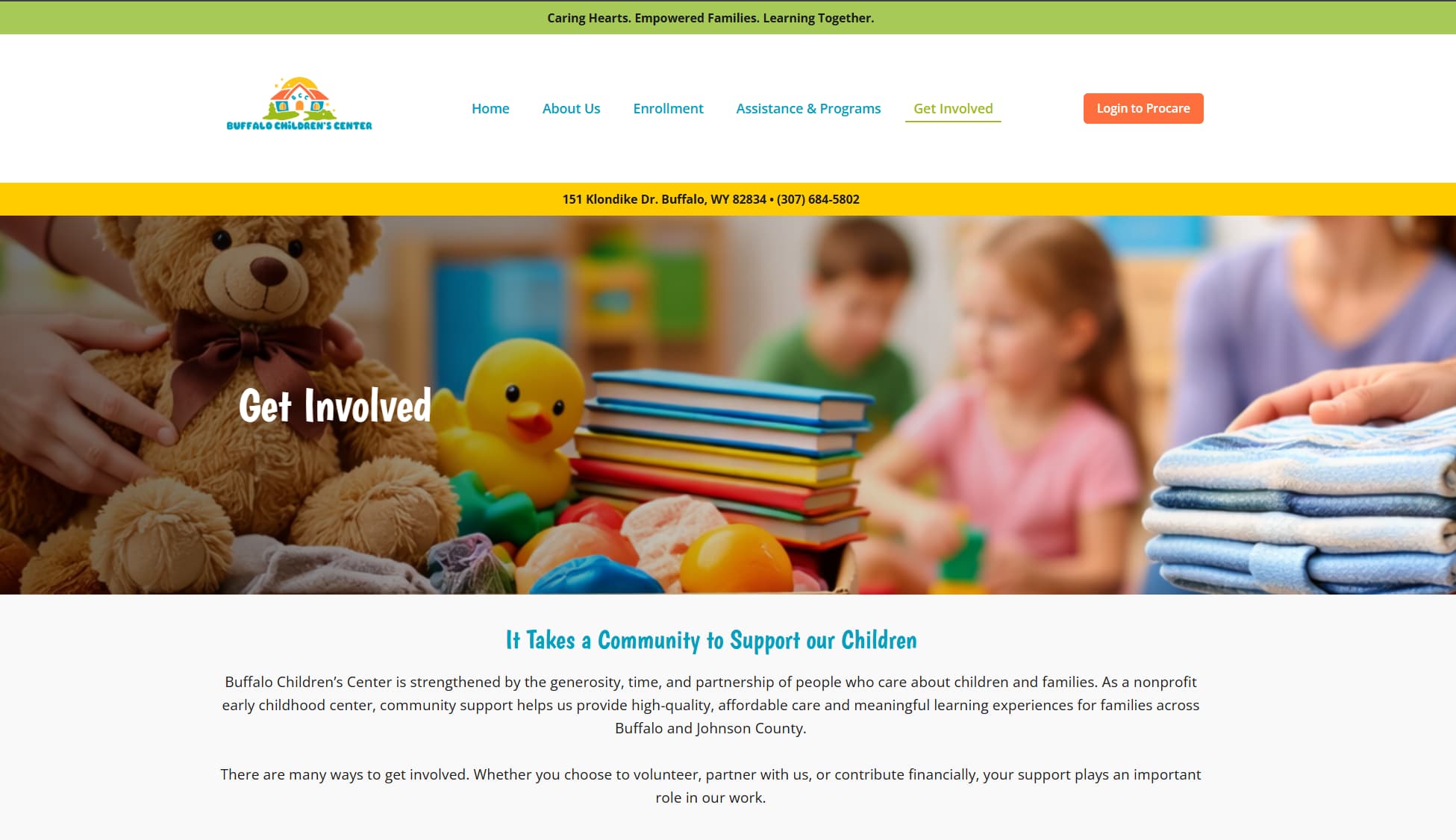
Bold hero imagery with controlled gradient overlay for legibility and consistent page entry point
The site needed to feel warm and inviting while also signaling that something new had begun. The reopening was a major shift, and the visual direction needed to reflect that without becoming loud or over-designed. It had to feel fresh and modern while remaining approachable and appropriate for childcare.
I favor bold hero sections that immediately ground the visitor. Each page uses a strong hero image with a soft gradient overlay so the text remains legible without feeling like a drag-and-drop template. Internal page content was intentionally constrained and structured so the reader can move through information cleanly, especially on mobile.
A centered text layout was a deliberate choice. It softens the tone compared to a traditional corporate left-aligned structure and gives the site a more welcoming, community-oriented feel. Spacing and typography were treated carefully, generous padding between sections prevents visual crowding and helps users retain their place, particularly on content-heavy pages viewed on smaller devices.
Warmth was introduced through controlled use of brand color. The bright logo colors were applied intentionally so they supported the design rather than dominating it. Hero imagery provides visual grounding and relief from saturated tones. Small, repeatable design elements, such as custom crayon dividers and background accents in lists and tables, add personality without undermining credibility. The result balances professionalism with warmth rather than choosing one over the other.
I approached this project with a deliberate challenge: learn a new CMS while applying established web architecture principles under a real timeline. AI was used early in the process to accelerate platform familiarity and evaluate template options, but within defined constraints, limited plugin use, modular flexibility, and a clean, lightweight build.
The initial template direction relied on additional block plugins. As my understanding of WordPress deepened, I determined that approach introduced unnecessary dependency and complexity. I restarted the build using the Twenty Twenty-Four theme and native Gutenberg blocks, removing third-party block plugins and reducing reliance on external tools. This decision required discarding work already completed, but it resulted in a more controlled and durable structure.
From that point forward, AI functioned as a reference and implementation assistant rather than a decision-maker. CSS and structural adjustments were generated based on my explicit instructions and requirements, then manually reviewed, refined, and tested by me before implementation. AI accelerated execution, but all architectural direction, validation, and final decisions remained mine.
The Twenty Twenty-Four theme provided the right foundation for this project. It allowed full-width hero, navigation, and footer elements while keeping interior content constrained and structured. It handled brand color and typography cleanly without requiring additional styling layers. Most importantly, it enabled a lightweight build without relying on third-party page builders or heavy block plugins.
Native Gutenberg blocks were used intentionally. The site will not receive constant technical oversight, and ownership will transition to the center’s director. Using default blocks ensures long-term stability and reduces dependency risk. If updates are needed in the future, they can be made using native WordPress functionality without requiring knowledge of external plugin systems.
Global custom CSS was implemented to centralize styling decisions and prevent accidental layout drift at the page level. This allowed design elements to be controlled in one place rather than scattered across individual blocks. It also enabled fine-grained adjustments not available in default controls, such as managing hero image focal behavior to prevent awkward cropping across screen sizes and zoom levels.
Plugin use was intentionally restrained to minimize breakpoints and long-term maintenance overhead. WebP images were used to reduce file size and improve load performance, particularly on mobile devices. Because the homepage hero spans the full viewport, image optimization was critical to offset the performance cost of large visual elements.
These decisions prioritized durability, clarity, and speed, ensuring the site can operate independently without frequent technical intervention while remaining flexible for future growth.
● Global hero system with full-width layout and standardized page structure.
● Consistent footer architecture with structured credibility and resource links.
● Custom template parts including hero framework and reusable crayon divider elements.
● Defined navigation system with mobile-first behavior and differentiated Procare access.
● Standardized button system (primary/secondary states, hover interaction).
● Constrained content layout pattern (full-width structural elements with restricted inner content width).
● On-page SEO implementation including keyword targeting, meta descriptions, metadata configuration, and proper heading hierarchy.
● Google Analytics (via Site Kit) and Search Console integration with verified indexing at launch.
● Jetpack forms configured with submissions viewable within the WordPress dashboard.
● Media optimization using WebP format for all applicable images, with intentional exceptions.
● Performance adjustments including hero loading optimization and speed tuning.
● Documented global CSS architecture with inline comments and centralized styling to support future adjustments.
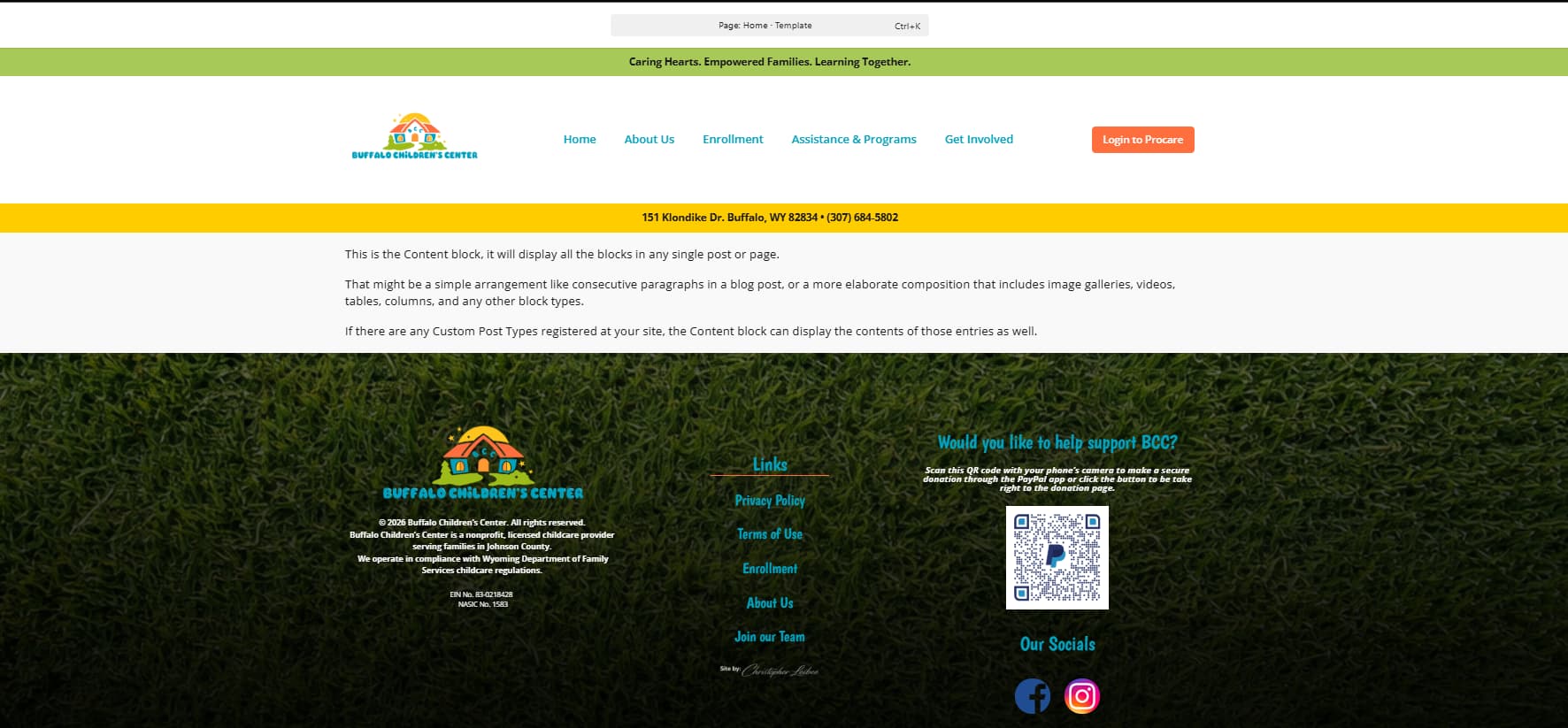
Global header and footer template parts built to centralize structure and protect long-term maintainability
● The site launched in alignment with the center’s targeted reopening timeline, despite shifting operational variables related to licensing, enrollment, and staffing.
● Google Analytics and Search Console were fully configured and verified live on day one, with indexing confirmed at launch.
● Post-launch mobile UX testing identified and resolved a touchscreen interaction issue in the navigation pill behavior on the day of release.
● Board review conducted following launch; site approved with strong positive reception.
● Procare login integration functioning as intended, with commitment to update integration if childcare software changes in the future.
● Site appeared on Google within days of launch, ranking among the top results for “Buffalo Wyoming childcare.”
● Performance benchmarks within acceptable range, with full-bleed hero load trade-offs intentionally managed.
● Ongoing support committed during the center’s operational stabilization phase.
● Further optimize full-bleed hero and footer image loading to reduce initial render time without compromising visual impact.
● Implement expanded GA4 event tracking once baseline traffic data is established.
● Refine certain block-level design decisions now that I have deeper familiarity with Gutenberg’s capabilities.
● Expand site content to support additional childcare programs and updated offerings.
● Develop a more structured backend file management approach for media and documents to improve long-term maintainability.
● Continue iterative SEO improvements based on real search data.
This project demonstrates my ability to take full ownership of a web platform and carry it from concept through launch without outside design or development support. I structured the architecture, controlled scope, made the necessary technical pivots, and delivered a stable system under real-world constraints.
The approach reflects systems-first thinking. The site was not assembled page-by-page. It was structured intentionally so it can expand without being rebuilt. Template parts, centralized styling, restrained plugin use, and disciplined layout decisions were made to protect long-term stability.
Architectural judgment was required when I recognized that the initial theme and plugin direction would introduce unnecessary dependency. I restarted the build on a lighter foundation, prioritizing durability over convenience.
Business awareness shaped both the structure and flow of the site. The design and navigation were structured first around clear access to information for families and the broader community. Content hierarchy and page flow were built to make enrollment details, program information, and operational updates easy to find without overwhelming the reader.
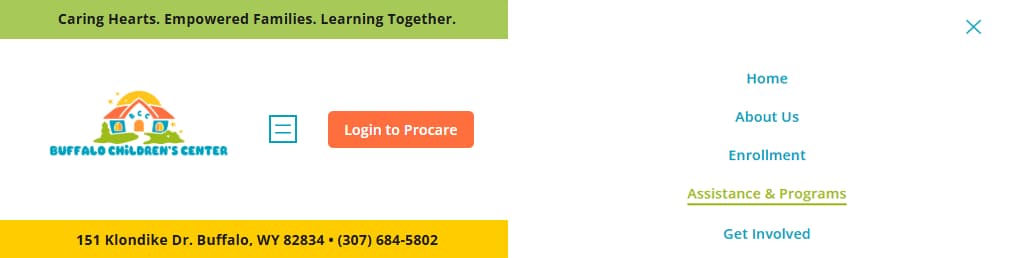
Mobile navigation — active state, differentiated Procare access, and simplified routing for parents and staff
Second, the site provides direct and reliable access to the childcare software platform used by both parents and staff. That routing was treated as a primary workflow, not an afterthought, ensuring the website supports daily operational use.
Finally, AI was used as an acceleration tool, not a substitute for decision-making. Direction, validation, and final implementation remained fully under my control.